Vaccinium macrocarpon
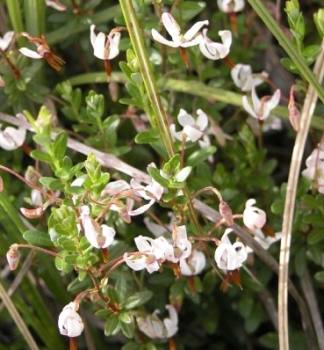 |
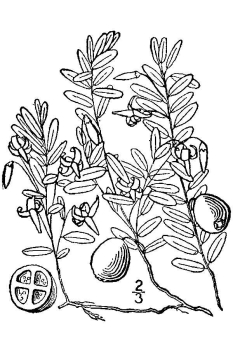 |
Photo Courtesy Renee Brecht |
Britton & Brown |
| Botanical name: | Vaccinium macrocarpon |
| Common name: | cranberry |
| Group: | dicot |
| Family: | Ericaceae |
| Growth type: | Subshrub; shrub |
| Duration: | perennial |
| Origin: | native |
| Plant height: | 4 - 8" |
| Foliage: | blunt or rounded tip, 1/4-3/4' long, pale or slightly whitened beneath, persisting over the winter |
| Flower: | 1/2" pale pink to white |
| Flowering time: | June to August; fruit September - October |
| Habitat: | bogs |
| Range in New Jersey: | statewide; locally common through the pine barrens |
| Heritage ranking, if any: | n/a |
| Distribution: | 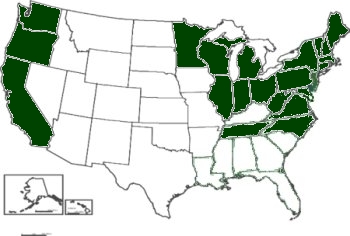 |
| Misc.: | Obligate wetlands species, i.e., Occurs almost always (estimated probability 99%) under
natural conditions in wetlands. Vaccinus, of cows, macrocarpon, large-fruited. Mastadons and cranberries? The legend of how the cranberry got its name may be found here. Information on cultivation, cultivars, nutrition, recipes, harvest, production, etc. may be found on the Wisconsin Cranberry page of the University of Wisconsin. This cranberry is commercially cultivated. Originally it was dry harvested with rakes; now, thanks to Whitesbog history and other local farmers, is harvested by flooding the bogs. Witmer Stone wrote of cranberry in 1911: "The usual procedure is to construct a dyke or dam across the stream which waters the tract and along the sides of the area also wherever the natural slope of the land is not sufficient to serve as a barrier; ditches are then cut through at intervals and the vines are planted. In the late autumn or early winter the floodgates are put down and the green bog becomes a spacious lake. Early in May the water is drawn off and after about two weeks the bog is again flooded for a few days to drown out certain insect pests which devour the vines. The bogs occasionally require to be sanded to lighten the soil and produce better growth. This is done in winter b spreading the sand over the ice, which when it melts, of course, deposits the sand evenly over the bog. "By September first the picking begins. Some of it is done by hand, but much of it by scoops provided with long slender fingers, which drawn lengthwise along the vines, pull the berries off into the hollow of the scoop. The berries that are scattered or lost from the scoops are often secured by flooding the bogs again, when they rise to the surface and can be scooped up wherever they collect. The picking ends about the middle of October and then the bogs are raked so as to draw all the vines in one direction to aid the gathering of the next crop. Several different types of berry have originated as the result of cultivation, a large ovoid one, the "Howell"; a more spherical berry, the ordinary Jersey form, and a smaller, darker one, the "Cape Cod". All are mere forms of O. macrocarpus. The picking was in old times done by the natives, but for some years past it has been almost entirely done by Italians, who are brought down from Philadelphia and other neighboring cities in large numbers, accompanied by their wives and families, all of whom aid in the work. Their camps, with blazing fires and music at night, are quite picturesque, offset as they are by the darkness of the surrounding forest and cedar swamps." (628) |