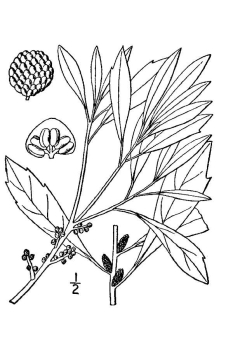
Morella cerifera
 |
Britton & Brown |
| Botanical name: | Morella cerifera |
| Common name: | wax myrtle |
| Synonomy: | Myrica pusilla Myrica cerifera Cerothamnus ceriferus |
| Group: | dicot |
| Family: | Myricaceae |
| Growth type: | tree; shrub |
| Duration: | perennial |
| Origin: | native |
| Plant height: | 6-12', multi-trunked |
| Foliage: | alternately arranged and clustered at the ends of the branches. They may be bluntly toothed or not. The upper and lower surfaces are covered with yellow circular glands that are visible under a hand-lens. |
| Flower: | very small, greenish-white |
| Flowering time: | early May to early June, before or with the leaves; fruits early August into September, persisting over winter.. |
| Habitat: | moist or wet ground of marshes, sand flats and pinelands, maritime forests, adjacent to salt marshes. |
| Range in New Jersey: | Rare on coast strip and Delaware Bay Shore but locally common in Cape May county. |
| Heritage ranking, if any: | n/a |
| Distribution: | 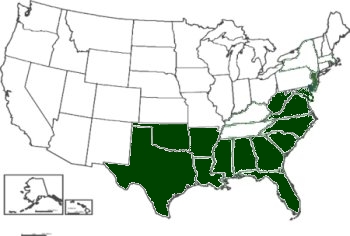 |
| Misc. | Morella cerifera reaches its northernmost limit in New Jersey. M. cerifera hybridizes with M. pensylvanica. There are both female and male plants. Niemcewicz, in "Under Their Vine and Fig Tree" (Travels through America, 1797-1799, 1805), wrote: "Its shores are completely sandy; in the middle it is covered with a thick and impassable wood of cedars, laurel, various thorns and laurel bushes, Myrtic [Myrica] Cerifera, commonly called Bayberry. This bush carries light green berries which are full of fat. The inhabitants boil these berries and, by adding a little tallow to the wax, make excellent candles. The color of these candles is green; the fragrance of the smoke is most pleasant, but the light is not as clear and strong as that of wax candle." (219-220) (Note: M. penslvanica was also used to make candles, and more commonly so.) The root bark and leaves were used medicinally (Hough, 240). Crushed leaves were rubbed on the skin to repel mosquitos and boughs were placed under beds to repel fleas. The fruits are a food source for birds, including migratory warblers. In fact, the Myrtle Warbler was named for its wintering association with M. cerifera. It is semi-evergreen to evergreen in warmer areas of the country. cerifera, wax-bearing (Latin). |