Erythronium americanum
 |
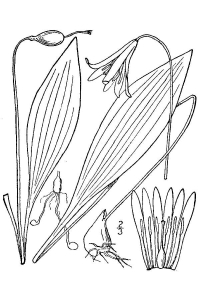 |
Photo courtesy Renee Brecht |
Britton & Brown |
| Botanical name: | Erythronium americanum ker Gawl |
| Common name: | trout lily; dog-tooth violet |
| Group: | monocot |
| Family: | Liliaceae |
| Growth type: | forb/herb |
| Duration: | perennial |
| Origin: | native |
| Plant height: | 4 - 10" |
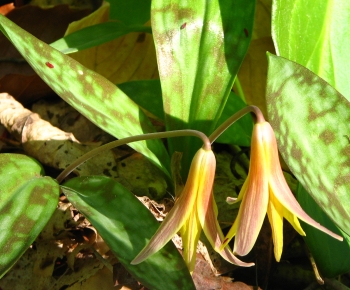
| Foliage: | Basal, petiolate Green leaves with purple mottling, reminiscent of speckled skin of a trout (hence the common name "trout" lily). Fertile plants generally have 2 leaves; sterile plants, one. |
| Flower: | yellow, 1" wide; 3 petals and 3 petal-like sepals |
| Flowering time: | March - May |
| Habitat: | rich, moist woods and meadows |
| Range in New Jersey: | all counties except Burlington, Atlantic, Cape May, Passaic, Essex, and Union |
| Heritage ranking, if any: | n/a |
| Distribution: | 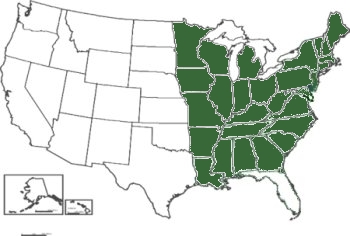 |
| Misc. | Erythronium americanum, from the Greek word erythros, meaning “red.” This is a reference either to the red flower or the reddish blotching of some Erythronium species. Low-growing plants that form colonies of plants of different ages. The youngsters are flowerless and have only one leaf, while older plants produce two leaves and a single flower. Traditionally the bulbs and leaves were eaten by Native Americans; the plants were also used for ulcers and as a contraceptive. Excessive ingestion of this plant can cause vomitting. Although one of the common names of this plant is "dogtooth violet", it refers to the shape of the corm; it is not a violet, but a lily. |