Arisaema triphyllum
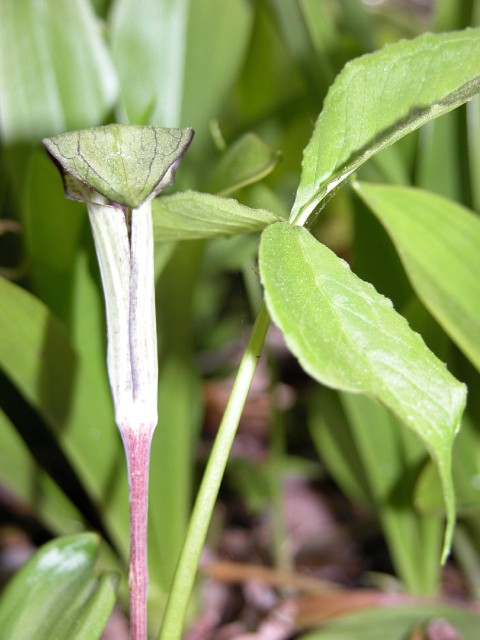 |
 |
Photo courtesy Renee Brecht |
Britton & Brown |
| Botanical name: | Arisaema triphyllum (L.) Schott |
| Common name: | Jack in the pulpit, Indian turnip |
| Group: | monocot |
| Family: | Araceae |
| Growth type: | forb/herb |
| Duration: | perennial |
| Origin: | native |
| Plant height: | 1 -3' |
| Foliage: | 1 or 2 leaves, long stalked, 3 parted |
| Flower: | tiny, within a "pulpit" (spathe) which is 3-4" in height |
| Flowering time: | late April to mid-May; fruits late July to August |
| Habitat: | moist to wet, shaded soils of woods and edges, swamps and bogs, slopes |
| Range in New Jersey: | statewide, outside the Pine Barrens |
| Heritage ranking, if any: | n/a |
| Distribution: |  |
| Misc. | Stone, in 1910, says of this plant, "The familiar
Jack-in-the-Pulpt is one of those plants that disappears as soon as we
enter the Pine Barrens. In northern and western Jersey we find it in
damp woods associated with the Skunk Cabbage, Dog-toothed Violet,
Spring Beauty and May Apple, but in the swamps of the Pine region not
one of the group is to be found."(314) The corm is edible after extensive drying or baking; the calcium oxalate crystals present in the plant prohibit it from being eaten raw. Native American peoples used A. triphyllum medicinally for sore eyes, rheumatism, bronchitis, colds, and various skin infections. Use of this plant internally can be deadly. |