Schwalbea americana
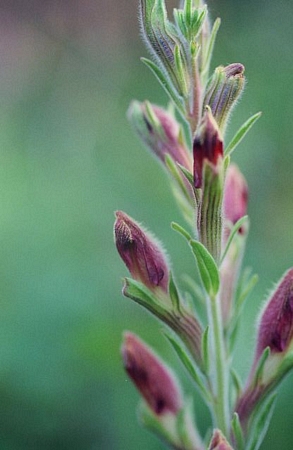 |
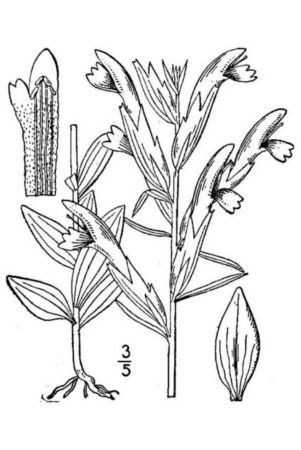 |
Photo Courtesy Renee Brecht |
Britton & Brown |
| Botanical name: | Schwalbea americana |
| Common name: | American chaffseed |
| Group: | dicot |
| Family: | Scrophulariaceae |
| Growth type: | forb/herb |
| Duration: | perennial |
| Origin: | native |
| Plant height: | 1'-2' |
| Foliage: | alternate, densely but minutely hairy, ��lance-shaped leaves, untoothed, and clasping the stem. |
| Flower: | reddish-purplish with yellow, 1 to 1-1/2 inches long |
| Flowering time: | early June-early July |
| Habitat: | sandy (sandy peat, sandy loam), acidic, seasonally moist to dry soils. It is generally found in habitats described as open, moist pine flatwoods, fire-maintained savannas, ecotonal areas between peaty wetlands and xeric sandy soils, and other open grass-sedge system |
| Range in New Jersey: | One known location within the Pine Barrens. |
| Heritage ranking, if any: | S1, State Endangered, Federally Endangered, Globally threatened, listed Pinelands |
| Distribution: | 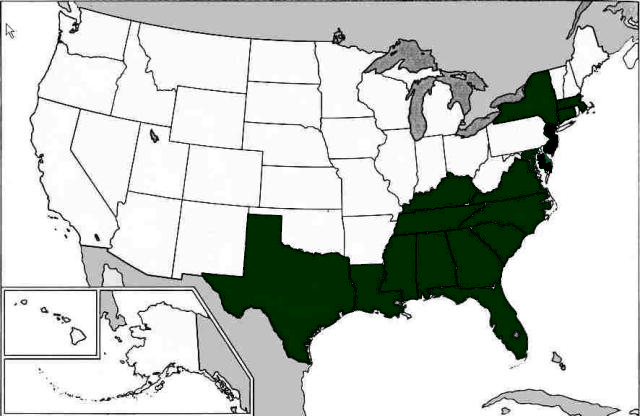 |
| Misc.: | USDA
lists as facultative upland: Usually occurs in non-wetlands (estimated
probability 67%-99%), but occasionally found on wetlands (estimated
probability 1%-33%). U.S. F&W Species Account: "American chaffseed is an erect perennial herb with unbranched stems (or stems branched only at the base) with large, purplish-yellow, tubular flowers that are borne singly on short stalks in the axils of the uppermost, reduced leaves (bracts). The leaves are alternate, lance-shaped to elliptic, stalkless, 2 to 5 centimeters (1 to 2 inches) long, and entire. The entire plant is densely, but minutely hairy throughout, including the flowers. Flowering occurs from April to June in the South, and from June to mid-July in the North. Chaffseed fruits are long, narrow capsules enclosed in a sac-like structure that provides the basis for the common name. Fruits mature from early summer in the South to October in the North. Schwalbea is a hemiparasite (partially dependent upon another plant as host). Like most of the hemiparasitic Scrophulariaceae, it is not host-specific, so its rarity is not due to its preference for a specialized host. Although another species (S. australis) was once recognized, the genus Schwalbea is now considered to be monotypic." A frequent fire regime is considered to be necessary for the survival of Schwalbea americana. |