Mitchella repens
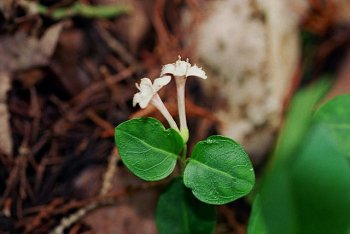 |
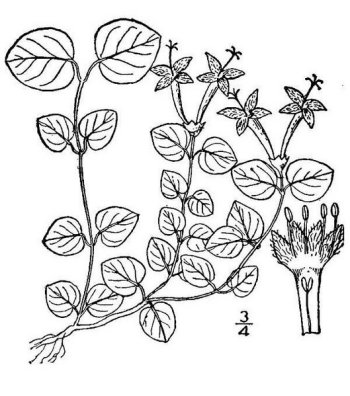 |
Photo courtesy Renee Brecht |
Britton & Brown |
| Botanical name: | Mitchella repens |
| Common name: | Partridge berry |
| Group: | dicot |
| Family: | Rubiaceae |
| Growth type: | Subshrub Shrub Forb/herb |
| Duration: | perennial |
| Origin: | native |
| Plant height: | 2" |
| Foliage: | opposite, ovate to cordate, with a pale yellow midrib. The petioles are short. Roots may grow at the internodes, forming loose mats. It is part of the undergrowh vegetation in many forests. |
| Flower: | White or pale pink, occuring in pairs (dimorphous). Both flowers share one calyx. Petals are covered with fine hairs. Each flower has one pistil and four stamens. While in one twin flower this pistil is short,in the other it is long. With a short pistil come long stamens, or vice versa. This dimorphy prevents self-fertilization by one flower. The two flower ovaries fuse after fertilization, resulting in one single red fruit with two dimples. |
| Flowering time: | Flowers late May to late June. Fruits in autumn, persisting over winter, often into spring. |
| Habitat: | woods, especially pine woods |
| Range in New Jersey: | Frequent in woods throughout the state, except in the Pine Barrens, where it occurs less frequently. |
| Heritage ranking, if any: | n/a |
| Distribution: |  |
| Misc. | USDA
lists as FACU, i.e.,Usually occur in non-wetlands (estimated probability 67% - 99%), but occasionally found in wetlands
(estimated probability 1% - 33%). The berries are edible though not particularly tasty. Each berry contains eight seeds. These berries are part of the diets of several birds, such as Ruffed Grouse, Sharp-tailed Grouse, Northern Bobwhite, and Prairie Chicken. The Red Fox, raccoons and White-tailed Deer seem to like it as well. The most common method of reproduction is vegetative, through division of the roots. Mitchella, named for John Mitchell, 17th century colonial botanist, physician, scientist, repens, spreading, creeping. |