Leiophyllum buxifolium
 |
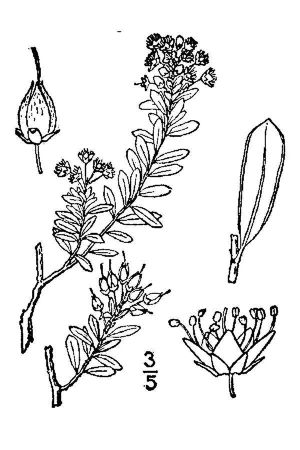 |
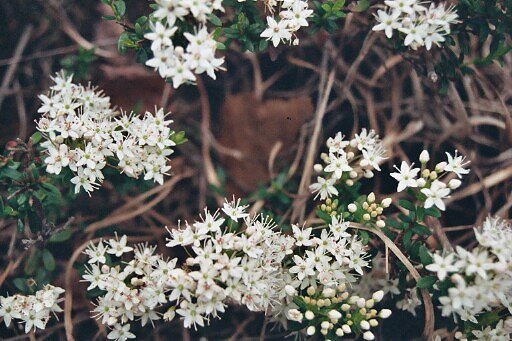
Photo courtesy Renee Brecht |
Britton & Brown |
| Botanical name: | Leiophyllum buxifolium |
| Common name: | Sand myrtle |
| Group: | dicot |
| Family: | Ericaceae |
| Growth type: | subshrub/shrub |
| Duration: | perennial |
| Origin: | native |
| Plant height: | 6" - 3' |
| Foliage: | alternate, simple, glossy dark green leaves up to 0.5" long; bronze winter color |
| Flower: | white; in bud, a rose-pink and white. 5 petalled, small, in terminal clusters; lavender stamens |
| Flowering time: | Fl. early May (rarely late April) to early June; Fr. early July through summer |
| Habitat: | damp open, sandy areas in the heart of the pine barrens of New Jersey |
| Range in New Jersey: | Frequent in the damp sand of the Pine Barrens, usually in open situations, finding here the northern limit of its range |
| Heritage ranking, if any: | n/a |
| Distribution: | 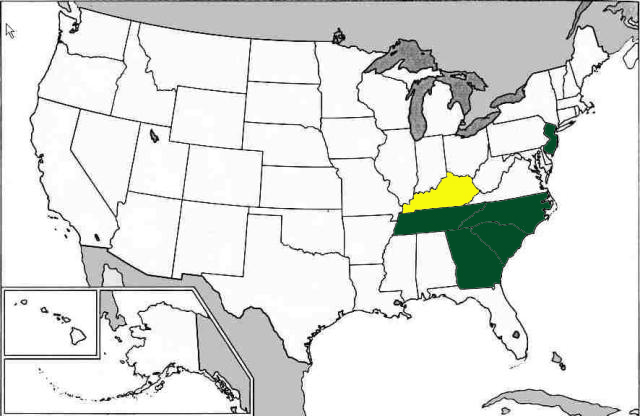 |
| Misc. | * yellow, above: range is historic USDA lists as facultative upland species: Usually occurs in non-wetlands (estimated probability 67%-99%), but occasionally found on wetlands (estimated probability 1%-33%). Stone notes: "This curious little evergreen, like a minature Box-bush, is typical of the very center of the Pines and does not range in New Jersey beyond the limits of this region. The white flowers, which it bears in great abundance, prove very attractive to various insects, and entomologists frequently haunt the patches of Sand Myrtle when searching for rarities."(616) Boyd notes "low, spreading, with many scraggly stems and branches. Bark rough, shreddy, brown. Leaves almost opposite, crowded, ovate, shiny dark green, leathery, evergreen."(126) "It is in a monotypic North American genus (a genus consisting of a single species). L. buxifolium is placed in the family Ericaceae because of its pollen structure; however, its flower rather resembles species from the Diapensiaceae family. L. buxifolium is geographically fragmented; it occurs in southern New Jersey (pine barrens), west into the mountains of the Carolinas, Tennessee, eastern Kentucky, and in northern Georgia (var. prostratum). In North Carolina and South Carolina it can be found on coastal plains." Center for Plant Conservation Genus Leiophyllum (Greek, leios, smooth, and phyllon, leaf). Species buxifolium (with leaves of box, Buxux) |